
How to build an AI operating system for a holding company: the architecture
An AI operating system for a holding consists of four layers: knowledge, roles, processes and control. The knowledge layer keeps the map of the business, roles execute work by protocol, processes connect systems into pipelines, control keeps decisions with the human.
Each of the four layers in this article is broken down to implementation level in the Academy — with protocols, templates and a step sequence for your business.
Open Academy tiers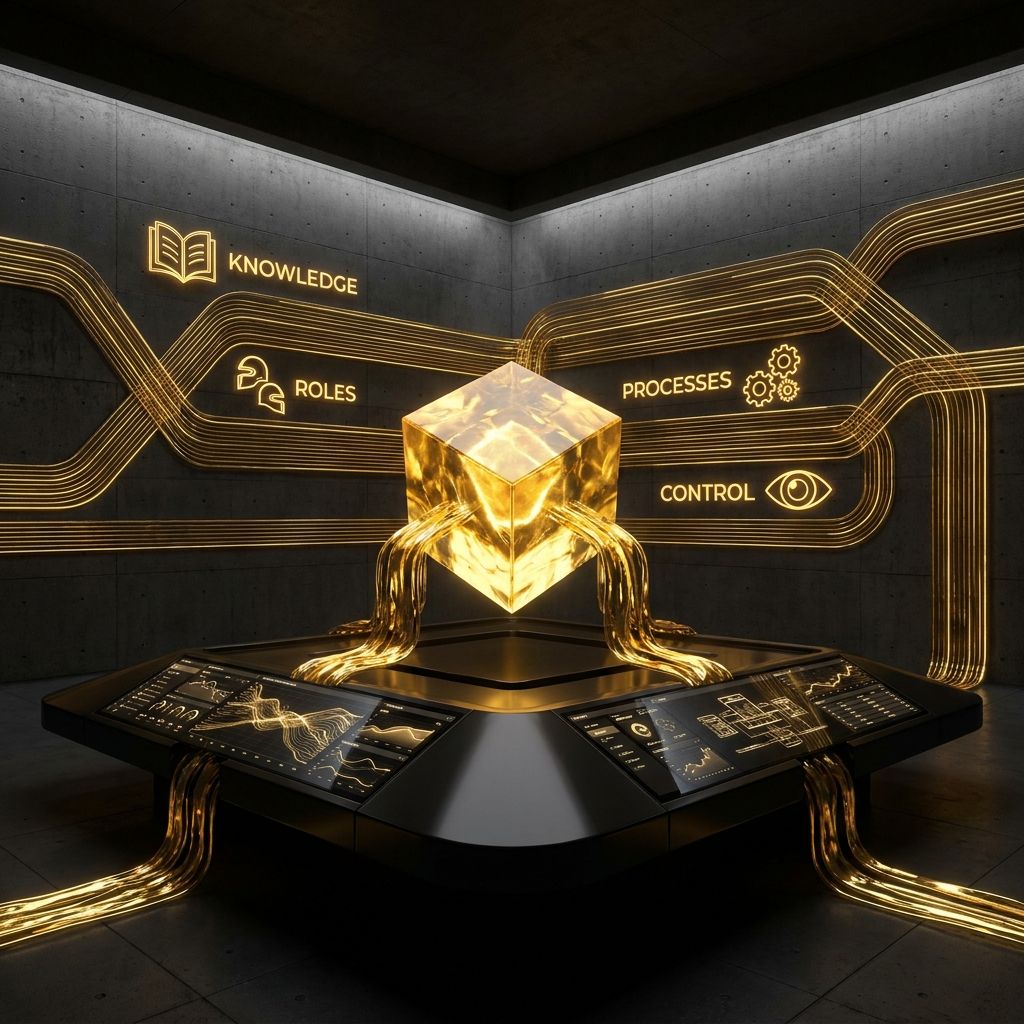
Here is each layer on the live architecture of GOLDJAXE OS.
The architecture grew out of practice: the holding first built the system to run its own companies and only then shaped it into a product. So every layer below is a working loop under real load — and it can be reproduced in another business.
Layer 1 · Knowledge: the twin and the wiki
The knowledge layer answers "how does this work here". Its core is the digital twin: an interactive map of companies, perimeters, AI agents and infrastructure (in GOLDJAXE — 130 links, 9 layers, 6 companies). Next to it sits the holding wiki, where every decision, incident and standard is a linked page.
The rule of this layer: knowledge lives in a system available to both the human and the AI. A document buried in private chats does not exist for the operating system.
Layer 2 · Roles: an AI team with zones of responsibility
Every AI role ships as a package: a work protocol, a zone of responsibility, activation triggers and hard limits. The legal analyst knows the holding’s jurisdictions, the designer knows the brand standard, the financial controller knows the structure of legal entities. GOLDJAXE runs 47 such roles on four levels.
Roles answer to orchestration: a complex task is decomposed across specialised roles, and the results are assembled into one answer for the principal. That is how a holding gets the effect of a team without a payroll.
Layer 3 · Processes: pipelines instead of manual chains
The process layer connects the systems: CRM, accounting, content production, messengers. Automation carries a deal from lead to closing documents, the content factory assembles assets station by station, notifications arrive where they will actually be read.
The GOLDJAXE content factory is one such pipeline: 7 stations, a 5-7 day asset cycle, one source asset unfolding into formats for several channels at once.
Layer 4 · Control: approvals and red lines
The control layer keeps the model safe. Red lines are the legal and reputational boundaries the system knows in advance and never crosses. Approvals are mandatory points of human decision: publications, payments, contracts, changes to production systems.
This layer is what makes the system fit for a real business: the speed of automation combined with responsibility that stays with the owner.
Where to start
The starting point is an inventory: which functions of the business are repeatable and describable by protocol, where knowledge is already digitised, which decisions must stay with the human. The GOLDJAXE AI diagnostic runs this audit in 90 seconds and returns a map of functions with an effect estimate.
FAQ
What layers does an AI operating system consist of?
Four layers: knowledge (digital twin and wiki), roles (an AI team with protocols), processes (automated pipelines) and control (human approvals and red lines).
Which layer should be built first?
The knowledge layer. While the map of the business and its standards live in heads and chats, AI roles have nothing to stand on. The twin and the wiki give the system common ground.
How long does the rollout take?
GOLDJAXE reference timelines: a digital twin of a business — 4 hours, an autonomous sales department — 2 weeks, your own AI-agent perimeter — 6 weeks.
More from the blog
 The Engine Room
AI integration for business: the GOLDJAXE methodology — from audit to a working AI team
AI integration for business means moving specific company functions — sales, content, accounting, document flow, production control — onto AI employees with a measurable result in money and hours. The GOLDJAXE methodology does it in five stages: function audit → architecture → implementation → quality gate → knowledge capture. What sets it apart from consulting decks is proof: our own holding is run by one person and an AI team of 25+ roles, and every element of the system is open on a live showcase — a digital twin with 213 nodes, an AI-team orbit, an ERP accounting circuit. This protocol covers how turnkey AI integration works: stages, architecture principles, real cases, cost, and where to start.
 The Engine Room
Three AI signals this week: business trusted AI, AI runs the chat, AI got a passport
Three things about AI agents landed this week: seven companies in ten already run them — but forty percent of security chiefs fear losing control; Meta opened its AI agent for customer chat to everyone, at a billion conversations a day; and Estonia became the first country to give AI agents a state passport. One signal for anyone running a business: AI stopped being an assistant and became an employee — with its own risks, access to the customer, and even papers.
 The Engine Room
This video — and this breakdown — wasn't made by a human. An AI employee did it in eight minutes
The short video under this text was made by an AI employee named Bella — in eight minutes, with no film crew and no editor. She found the news through the holding's intelligence system, wrote the script, voiced it in her own voice, edited the video and published it to eight social platforms. Herself. This is the working content pipeline of a holding run by one person, where AI employees handle the routine. And that pipeline now costs about what a single agency post used to.